
The gap between the rich and the poor is growing in the United States and has been for decades. The topic came to the forefront of the national debate last year with the rise of Occupy Wall Street. However, a growing income gap may not be the problem that some make it out to be.
The evidence that growing inequality hurts the middle class and poor is weak, as Scott Winship, a fellow at Washington-based think tank the Brookings Institution, testified to the Senate Budget Committee today at a hearing about inequality and economic mobility. "There is very little evidence to suggest that the gains at the top have come at the expense of other Americans," he said.
Without question, income inequality has grown substantially in the United States. According to an October report from the Congressional Budget Office, a nonpartisan agency that provides economic data to Congress, real income for the top 1 percent of the population grew by 275 percent between 1979 and 2007. Meanwhile, household income for the middle 60 percent of the population grew by just under 40 percent, and for the bottom 20 percent, it grew by just 18 percent. That's a wide disparity, but explosive income growth for the richest Americans isn't necessarily detrimental to the poorest Americans.
As an example, Winship pointed to Mitt Romney, who made $22 million or so in 2010, and Mark Zuckerberg, who could make $5 billion off of his stock options this year. "Should we be concerned about the poorer man?" asked Winship. In other words, extreme economic inequality isn't always problematic; it's simply a fact of life as some Americans get fantastically richer and skew the numbers even further. This means that the income gap within the bottom 99 percent has grown much more slowly than that between the 99 percent and the top 1 percent. This means that a tiny segment of the richest Americans has an increasingly large impact on measures of inequality, though the negative impact on other Americans may be minimal.
"How will the typical American end up better off if the Facebook IPO were to fall through so that Zuckerberg could not exercise his options?" said Winship in his opening statement.
While the problems of inequality can be deceptive and perhaps overstated, growing income disparities can point to larger economic problems. For example, the CBO has cited a lack of skilled labor as one contributing factor to inequality, as demand and pay grow for rare skilled workers. Better education, particularly in STEM fields, could mean a better chance at a better life for many.
Likewise, while income gaps continue to grow, economic mobility--the ability to move up (or down) the income ladder--is very limited.
Continue ►
Showing posts with label finance and investment. Show all posts
Showing posts with label finance and investment. Show all posts
Thursday, February 9, 2012

Tuesday, February 7, 2012
Stock hold gains, erasing early losses

NEW YORK (AP) -- Stocks are ending higher as Greece appeared close to announcing a deal with creditors to reduce its debt.
The Dow Jones industrial average ended at its highest level since May 2008 Tuesday.
The Dow rose 33 points to close at 12,878. It hasn't closed higher since May 2008, before the financial crisis. It had been down as many as 62 points in the first half-hour of trading.
The Standard & Poor's 500 gained 3 points to 1,347. The Nasdaq composite rose 2 points to 2,904.
Indexes rose on a report that Greek leaders will soon tell European finance ministers they've formed a deal to reduce the country's massive debt. Stocks also rose on news that U.S. job openings soared to the highest level in nearly three years in December. Continue ►
Friday, August 19, 2011
Sound of "credit repair" as a miracle? It is not the case. It is rather a euphemism for working hard and effective!
The plight of the economy have fostered the growth of many companies, time-based. "For example, the"credit repair"emerged and commercial repair credit '.". These monikers involve a bad credit rating to become a good grade is a simple matter of applying a "solution" or "fix" your credit report, using a big, tips and techniques for all new wonderful project. Often, these companies posture themselves as lawyers ' offices, increase your confidence in their legitimacy and effectiveness. For those of us with debt problems and the problems of the credit rating, many people go to the bait, with a great sigh of relief. "phew!" I am just happy that I can pay a nominal fee and obtain my credit fixed! Then I "ll be in business!
The truth is that you must pay each debt which may be committed, or credit rating remains the same: evil! Unpaid debts remain on your report of credit for seven years, the time in which "roll-off". Seven years is long suffering from a bad credit rating, pay the highest APR in each line of credit is obtained. The loan of the car to store gas cards, debit cards: almost everything you buy on credit: will cost much more interest that methodically clean up your credit, pay their debts. Some smaller debts can be cancelled before the age of seven years, but large debts usually end by the creditor obtaining a judgment against you.
Therefore, if really is buried in debt and you want to clean up your credit correctly, gradually and in good faith, what to do? "Credit repair" or "credit repair" does not exactly describes the work to be done. Here, we give a list of what to do, from top to bottom, to really solve your credit.
1 Obtain a more recent copy of your credit report. Line by line, make sure that each debt is yours, highlighting those that are not.
2 Get in contact with each creditor falsely report a debt against you. Application of test (documentation) that the debt is yours. This must be provided within 30 days of receipt of your request. If it cannot or does not provide such evidence, must remove debt from your credit report. It is the law.
3 Assume that it has several final payments showing on your credit report. The only ' credit correction "" that can be applied here speaks with its creditors, explaining the mitigating circumstances that encourages not payment in a timely manner. "" In doing that when you are on the right track, at least 3 months of payments in a timely manner under his belt. You can have the creditor waives certain end sanctions, which helps to $75 to break!
4 Take a look at small debts that shows one. It can be administered to reduce certain luxury goods and for each of these small paid articles? If so, make the!
5 Consider a debt consolidation loan, all monthly credit packages in a smaller monthly payment obligations. This improves the monthly cash flow, allowing you to get the speed on the Elimination of these guys. Go to an organization-for-profit debt consolidation services, where the rate will be less and really have a champion in your corner. Then, make the payment on time, every time!
6. In the course of this period a real "credit fix" background, Don't go for any new credit! "Work on what you already have your plate, so that you are ready.
There, you now have a precise definition of "credit repair" and a "credit repair". For it and get the benefits!
The truth is that you must pay each debt which may be committed, or credit rating remains the same: evil! Unpaid debts remain on your report of credit for seven years, the time in which "roll-off". Seven years is long suffering from a bad credit rating, pay the highest APR in each line of credit is obtained. The loan of the car to store gas cards, debit cards: almost everything you buy on credit: will cost much more interest that methodically clean up your credit, pay their debts. Some smaller debts can be cancelled before the age of seven years, but large debts usually end by the creditor obtaining a judgment against you.
Therefore, if really is buried in debt and you want to clean up your credit correctly, gradually and in good faith, what to do? "Credit repair" or "credit repair" does not exactly describes the work to be done. Here, we give a list of what to do, from top to bottom, to really solve your credit.
1 Obtain a more recent copy of your credit report. Line by line, make sure that each debt is yours, highlighting those that are not.
2 Get in contact with each creditor falsely report a debt against you. Application of test (documentation) that the debt is yours. This must be provided within 30 days of receipt of your request. If it cannot or does not provide such evidence, must remove debt from your credit report. It is the law.
3 Assume that it has several final payments showing on your credit report. The only ' credit correction "" that can be applied here speaks with its creditors, explaining the mitigating circumstances that encourages not payment in a timely manner. "" In doing that when you are on the right track, at least 3 months of payments in a timely manner under his belt. You can have the creditor waives certain end sanctions, which helps to $75 to break!
4 Take a look at small debts that shows one. It can be administered to reduce certain luxury goods and for each of these small paid articles? If so, make the!
5 Consider a debt consolidation loan, all monthly credit packages in a smaller monthly payment obligations. This improves the monthly cash flow, allowing you to get the speed on the Elimination of these guys. Go to an organization-for-profit debt consolidation services, where the rate will be less and really have a champion in your corner. Then, make the payment on time, every time!
6. In the course of this period a real "credit fix" background, Don't go for any new credit! "Work on what you already have your plate, so that you are ready.
There, you now have a precise definition of "credit repair" and a "credit repair". For it and get the benefits!
Tuesday, August 16, 2011
Add a personal style with a layer of tissue Treasury account
What is the first thing that gets to open a new check below at your local bank account? In the day, which is used to be a toaster or other small device, but few places do now. On the other hand, is likely to get a couple of caps in plastic corny for new Treasury bills. I don't know about you, but I absolutely hate these things. I am the kind of person who enjoys a bit of style and color in my life and therefore immediately replaces these things in plastic with a layer of tissue of my own design Treasury account.
I started with a layer of tissue account of Treasury about five years after I made my own when I learned to sew. A layer of tissue of the Treasury Board has seemed an ideal first project because it is relatively easy to do, it is also very convenient. I looked for some profiles online, they saw a couple of video tutorials and then I radiée on my own. It is true that they are not exactly the way he had hoped that you first, but after several attempts, I could produce a decent specimen.
I am now a new account of Treasury fabric for me covered every six months or less. I am now much better sewing and if I am able to do some fairly specific models. Bright colours and the designs are very very striking (if what I say) and I have received many gathered for my blankets. With my current inventory, I could change my coverage of the fabric Treasury account each month for a year without using the same twice. This is the kind of variety that I love you!
Around the world say that I know that it must change to an account of cash instead of plastic fabric cover. When the old plastics have tendency to crack and other signs of decomposition. We cannot say how many times I scraped I or took me a manga in a jagged edge. It was something very common and annoying, my days of plastic stoppers, but fortunately it happen more. Most of my friends is ready to make the change for this reason that only only.
I've developed more confidence in my skills with a needle and thread, I even started to create blankets as gifts for friends. It is very gratifying to see another person to use a layer of tissue account of Treasury that I spent a few hours to do, and it is good to know that the recipient is to take some advantage of Don, as well.
If you always use plastic covers for your controls, it is absent so incredible to express your personality and your sense of style. Next time, try to make or buy an account of the Treasury of cloth covered instead. I think that you be pleasantly surprised with results!
Wednesday, June 22, 2011
Dollar Gaints As Bernanke Cites Economic Hurdles
NEW YORK (MarketWatch) — The dollar strengthened Tuesday as Federal Reserve Chairman Ben Bernanke highlighted obstacles to a U.S. recovery and euro-zone debt concerns, prompting a selloff in stocks and raising the value of the greenback as a safe haven.
The dollar index /quotes/zigman/1652083 DXY -0.07% , which measures the performance of the U.S. unit against a basket of six other major currencies, rose against a basket of rivals to 74.791 from 74.553 late Tuesday, picking up strength as Bernanke briefed reporters following the Fed’s monetary-policy statement and economic forecast.
“Bernanke seemed to be focused on the persistent headwinds to a U.S. recovery,” said David Watt, senior currency strategist at RBC Capital Markets. “This got the market cautious about the U.S. economic outlook.”
“As he spoke, equities faded, and the dollar rallied,” Watts said, adding that the dollar exhibited the strongest moves when Bernanke focused on the uncertainty of the recovery and the strains on the European Union.
Bernanke said there was “uncertainty” about how much of the recent U.S. slowdown was permanent or transitory. He also said that while U.S. banks’ direct exposure to Greece was small, a disorderly sovereign bond default would likely roil financial markets and have a “significant” impact on the United States.
The euro /quotes/zigman/4867933/sampled EURUSD -0.27% was last trading at $1.4360, up from $1.4305 late Tuesday but off session highs of $1.4441 . See real-time currency quotes and tools.
U.S. stocks, which had been trading near flat ahead of the afternoon press conference, ended with broad losses. The Dow Jones Industrial Average /quotes/zigman/627449/delayed DJIA -0.66% fell 80 points to 12,110, with all but two stocks lower. Read more on U.S. stocks.
The dollar’s rise during Bernanke’s appearance continued its upward movement through the day. The dollar index rose to 74.677 after the Federal Reserve released its statement on monetary policy Tuesday afternoon.
The Federal Open Market Committee kept interest rates near 0% and said, as expected, that it was ending its $600 billion bond-buying program on schedule by the end of this month. The decision was unanimous.
“The absence of a dissent for a third meeting sends a strong message to financial markets that the Fed is committed to zero interest rates for the foreseeable future,” said Michael Woolfolk, currency strategist at BNY Mellon Global Markets. But also, Woolfolk said, the committee gave no sign it was extending or embarking on a new quantitative easing program.
“Quantitative easing appears to be dead and buried, may it rest in peace,” he wrote.
Watts said that Bernanke had appeared to offer mixed signals.
“While he said there was no more quantitative easing in the pipeline, he didn’t go out of way to show that there might not be no possibility,” said Watts, “It is a confusing hash.”
Low interest rates put a currency at a disadvantage. And for the past two years, the Fed has taken a step beyond reducing its benchmark rate to historic lows by buying bonds from the private sector. This extra monetary stimulus, known as quantitative easing, has contributed to the dollar’s 16% drop in the last year.
The dollar index /quotes/zigman/1652083 DXY -0.07% , which measures the performance of the U.S. unit against a basket of six other major currencies, rose against a basket of rivals to 74.791 from 74.553 late Tuesday, picking up strength as Bernanke briefed reporters following the Fed’s monetary-policy statement and economic forecast.
“Bernanke seemed to be focused on the persistent headwinds to a U.S. recovery,” said David Watt, senior currency strategist at RBC Capital Markets. “This got the market cautious about the U.S. economic outlook.”
“As he spoke, equities faded, and the dollar rallied,” Watts said, adding that the dollar exhibited the strongest moves when Bernanke focused on the uncertainty of the recovery and the strains on the European Union.
Bernanke said there was “uncertainty” about how much of the recent U.S. slowdown was permanent or transitory. He also said that while U.S. banks’ direct exposure to Greece was small, a disorderly sovereign bond default would likely roil financial markets and have a “significant” impact on the United States.
The euro /quotes/zigman/4867933/sampled EURUSD -0.27% was last trading at $1.4360, up from $1.4305 late Tuesday but off session highs of $1.4441 . See real-time currency quotes and tools.
U.S. stocks, which had been trading near flat ahead of the afternoon press conference, ended with broad losses. The Dow Jones Industrial Average /quotes/zigman/627449/delayed DJIA -0.66% fell 80 points to 12,110, with all but two stocks lower. Read more on U.S. stocks.
The dollar’s rise during Bernanke’s appearance continued its upward movement through the day. The dollar index rose to 74.677 after the Federal Reserve released its statement on monetary policy Tuesday afternoon.
The Federal Open Market Committee kept interest rates near 0% and said, as expected, that it was ending its $600 billion bond-buying program on schedule by the end of this month. The decision was unanimous.
“The absence of a dissent for a third meeting sends a strong message to financial markets that the Fed is committed to zero interest rates for the foreseeable future,” said Michael Woolfolk, currency strategist at BNY Mellon Global Markets. But also, Woolfolk said, the committee gave no sign it was extending or embarking on a new quantitative easing program.
“Quantitative easing appears to be dead and buried, may it rest in peace,” he wrote.
Watts said that Bernanke had appeared to offer mixed signals.
“While he said there was no more quantitative easing in the pipeline, he didn’t go out of way to show that there might not be no possibility,” said Watts, “It is a confusing hash.”
Low interest rates put a currency at a disadvantage. And for the past two years, the Fed has taken a step beyond reducing its benchmark rate to historic lows by buying bonds from the private sector. This extra monetary stimulus, known as quantitative easing, has contributed to the dollar’s 16% drop in the last year.
Thursday, January 20, 2011
FORTUNE's Best Companies to Work for 2011
by Fortune Magazine: Milton Moskowitz, Robert Levering & Christopher Tkaczyk
Each year Fortune compiles its list of the 100 Best Companies to Work For. Based largely on employee surveys, this list is significant for all those who are not just looking for a job, but also a great experience at work.

We've listed the top ten of Fortune's 2011 list below. This year eight of the top ten companies from last year were able to maintain there exclusive ranking. The two new additions are companies you've likely heard of before; they're online shoe retailer Zappos.com and outdoor product purveyor Recreational Equipment (REI)
So without further adieu, here are the top ten companies to work for...
01. SAS
Rank: 1 (Previous rank: 1)
What makes it so great?
A 14-year veteran of this list, the software firm takes the top spot for the second year running.
Its perks are epic: on-site healthcare, high quality childcare at $410 per month, summer camp for kids, car cleaning, a beauty salon, and more -- it's all enough to make a state-of-the-art, 66,000-square-foot gym seem like nothing special by comparison.
This year, strong employee feedback sent its numbers even higher. Says one manager: "People stay at SAS in large part because they are happy, but to dig a little deeper, I would argue that people don't leave SAS because they feel regarded -- seen, attended to and cared for. I have stayed for that reason, and love what I do for that reason."
2009 revenue ($ millions): 2,310
02. Boston Consulting Group
Rank: 2 (Previous rank: 8)
What makes it so great?
The consulting giant not only avoided layoffs in the downturn, but hired its largest class of recruits ever in 2010.
They're drawn by the firm's generous pay and a commitment to social work: Its Social Impact Practice Network (SIPN) offers a chance to work with the U.N. World Food Program and Save the Children, while BCG pulled its consultants off client projects to provide on-the-ground support in Haiti following the earthquake.
The company jumps up from no. 8 last year.
03. Wegmans Food Markets
Rank: 3 (Previous rank: 3)
What makes it so great?
This customer-friendly supermarket chain cares about the well-being of its workers, too. This year, 11,000 employees took part in a challenge to eat five cups of fruit and vegetables a day and walk up to 10,000 steps a day for eight weeks.
Another 8,000 took advantage of health screenings that included a flu shot and H1N1 vaccine -- all covered by Wegmans.
2009 revenue ($ millions): 5,193
04. Google
Rank: 4 (Previous rank: 4)
What makes it so great?
The search giant is famous for its laundry list of perks including free food at any of its cafeterias, a climbing wall, and, well, free laundry.
Last year, with revenue up more than 20%, Google sweetened this already rich pot of perks by giving every employee a 10% pay hike. Googlers can also award one another $175 peer spot bonuses -- last year more than two-thirds of them did so.
2009 revenue ($ millions): 23,651
05. NetApp
Rank: 5 (Previous rank: 7)
What makes it so great?
It was a rebound year for the data-storage firm (no. 1 in 2009), as revenues jumped 33% and it hired hundreds of new employees.
Hourly executive assistants make $76,450 a year here, supplemented by a bonus of $21,917.
Employees also enjoy perks like free fruit on Tuesdays, free bagels and cream cheese on Fridays, and free espresso all the time.
2009 revenue ($ millions): 3,931
06. Zappos.com
Rank: 6 (Previous rank: 15)
What makes it so great?
The online shoe retailer makes a big leap from no. 15 to no. 6 this year.
Now part of the Amazon.com family, the company's quirky, happy culture remains: Employees enjoy free lunches, no-charge vending machines, a full-time life coach on hand, and "create fun and a little weirdness" as one of the company's guiding tenets.
2009 revenue ($ millions): 1,190
07. Camden Property Trust
Rank: 7 (Previous rank: 10)
What makes it so great?
The Houston-based apartment management firm weathered the recession as employees pitched in to trim $6 million in costs, largely by renegotiating contracts and reducing pay.
One team sent a scrapbook to the CEO to show how much they love the company, while another planned and organized a "flash mob" dance routine for leaders' benefit.
One popular perk: Staffers can rent furnished apartments for $20 a night in locations like Orlando, San Diego, Denver and Austin for use on personal vacations.
2009 revenue ($ millions): 624
08. Nugget Market
Rank: 8 (Previous rank: 5)
What makes it so great?
Rallies are an everyday event at this nine-store Northern California supermarket chain, where management uses a big flat screen computer monitor in each store to deliver important information about products, messages from the leadership team, employee awards, and pump up the troops.
Employees who watch diligently can be rewarded with bonuses that range from $20 to $1,500. Universal perk: everyone receives a 10% discount on store purchases.
2009 revenue ($ millions): 288
09. Recreational Equipment (REI)
Rank: 9 (Previous rank: 14)
What makes it so great?
After 15 years of service, employees at this adventure gear retailer are entitled to a four-week paid sabbatical; after that, they can take one every five years.
Employees also receive 50%-75% discounts on full-price REI branded apparel and equipment, free rental of equipment like skis and kayaks, and an annual gift of REI gear.
A separate Challenge Grant program provides up to $300 worth of gear to employees that participate in a challenging outdoor adventure (one cycled 500 miles across Iowa).
2009 revenue ($ millions): 1,455
10. DreamWorks Animation SKG
Rank: 10 (Previous rank: 6)
What makes it so great?
The creators of Shrek and Kung Fu Panda are lavished with free breakfast and lunch, movie screenings, afternoon yoga, on-campus art classes and monthly parties.
CEO Jefferey Katzenberg still takes time to call job candidates to encourage them to join.
Any DreamWorker can pitch a movie idea to company executives -- and can take the company-sponsored "Life's A Pitch" workshop to learn how best to do it.
2009 revenue ($ millions): 725 Continue ►
Each year Fortune compiles its list of the 100 Best Companies to Work For. Based largely on employee surveys, this list is significant for all those who are not just looking for a job, but also a great experience at work.
We've listed the top ten of Fortune's 2011 list below. This year eight of the top ten companies from last year were able to maintain there exclusive ranking. The two new additions are companies you've likely heard of before; they're online shoe retailer Zappos.com and outdoor product purveyor Recreational Equipment (REI)
So without further adieu, here are the top ten companies to work for...
01. SAS
Rank: 1 (Previous rank: 1)
What makes it so great?
A 14-year veteran of this list, the software firm takes the top spot for the second year running.
Its perks are epic: on-site healthcare, high quality childcare at $410 per month, summer camp for kids, car cleaning, a beauty salon, and more -- it's all enough to make a state-of-the-art, 66,000-square-foot gym seem like nothing special by comparison.
This year, strong employee feedback sent its numbers even higher. Says one manager: "People stay at SAS in large part because they are happy, but to dig a little deeper, I would argue that people don't leave SAS because they feel regarded -- seen, attended to and cared for. I have stayed for that reason, and love what I do for that reason."
2009 revenue ($ millions): 2,310
02. Boston Consulting Group
Rank: 2 (Previous rank: 8)
What makes it so great?
The consulting giant not only avoided layoffs in the downturn, but hired its largest class of recruits ever in 2010.
They're drawn by the firm's generous pay and a commitment to social work: Its Social Impact Practice Network (SIPN) offers a chance to work with the U.N. World Food Program and Save the Children, while BCG pulled its consultants off client projects to provide on-the-ground support in Haiti following the earthquake.
The company jumps up from no. 8 last year.
03. Wegmans Food Markets
Rank: 3 (Previous rank: 3)
What makes it so great?
This customer-friendly supermarket chain cares about the well-being of its workers, too. This year, 11,000 employees took part in a challenge to eat five cups of fruit and vegetables a day and walk up to 10,000 steps a day for eight weeks.
Another 8,000 took advantage of health screenings that included a flu shot and H1N1 vaccine -- all covered by Wegmans.
2009 revenue ($ millions): 5,193
04. Google
Rank: 4 (Previous rank: 4)
What makes it so great?
The search giant is famous for its laundry list of perks including free food at any of its cafeterias, a climbing wall, and, well, free laundry.
Last year, with revenue up more than 20%, Google sweetened this already rich pot of perks by giving every employee a 10% pay hike. Googlers can also award one another $175 peer spot bonuses -- last year more than two-thirds of them did so.
2009 revenue ($ millions): 23,651
05. NetApp
Rank: 5 (Previous rank: 7)
What makes it so great?
It was a rebound year for the data-storage firm (no. 1 in 2009), as revenues jumped 33% and it hired hundreds of new employees.
Hourly executive assistants make $76,450 a year here, supplemented by a bonus of $21,917.
Employees also enjoy perks like free fruit on Tuesdays, free bagels and cream cheese on Fridays, and free espresso all the time.
2009 revenue ($ millions): 3,931
06. Zappos.com
Rank: 6 (Previous rank: 15)
What makes it so great?
The online shoe retailer makes a big leap from no. 15 to no. 6 this year.
Now part of the Amazon.com family, the company's quirky, happy culture remains: Employees enjoy free lunches, no-charge vending machines, a full-time life coach on hand, and "create fun and a little weirdness" as one of the company's guiding tenets.
2009 revenue ($ millions): 1,190
07. Camden Property Trust
Rank: 7 (Previous rank: 10)
What makes it so great?
The Houston-based apartment management firm weathered the recession as employees pitched in to trim $6 million in costs, largely by renegotiating contracts and reducing pay.
One team sent a scrapbook to the CEO to show how much they love the company, while another planned and organized a "flash mob" dance routine for leaders' benefit.
One popular perk: Staffers can rent furnished apartments for $20 a night in locations like Orlando, San Diego, Denver and Austin for use on personal vacations.
2009 revenue ($ millions): 624
08. Nugget Market
Rank: 8 (Previous rank: 5)
What makes it so great?
Rallies are an everyday event at this nine-store Northern California supermarket chain, where management uses a big flat screen computer monitor in each store to deliver important information about products, messages from the leadership team, employee awards, and pump up the troops.
Employees who watch diligently can be rewarded with bonuses that range from $20 to $1,500. Universal perk: everyone receives a 10% discount on store purchases.
2009 revenue ($ millions): 288
09. Recreational Equipment (REI)
Rank: 9 (Previous rank: 14)
What makes it so great?
After 15 years of service, employees at this adventure gear retailer are entitled to a four-week paid sabbatical; after that, they can take one every five years.
Employees also receive 50%-75% discounts on full-price REI branded apparel and equipment, free rental of equipment like skis and kayaks, and an annual gift of REI gear.
A separate Challenge Grant program provides up to $300 worth of gear to employees that participate in a challenging outdoor adventure (one cycled 500 miles across Iowa).
2009 revenue ($ millions): 1,455
10. DreamWorks Animation SKG
Rank: 10 (Previous rank: 6)
What makes it so great?
The creators of Shrek and Kung Fu Panda are lavished with free breakfast and lunch, movie screenings, afternoon yoga, on-campus art classes and monthly parties.
CEO Jefferey Katzenberg still takes time to call job candidates to encourage them to join.
Any DreamWorker can pitch a movie idea to company executives -- and can take the company-sponsored "Life's A Pitch" workshop to learn how best to do it.
2009 revenue ($ millions): 725 Continue ►
Wednesday, January 19, 2011
Disney bags contain high levels of lead
The Center for Environmental Health (CEH), a national eco-watchdog group, is always on the lookout for toxins in consumer products, particularly in children's products. They found them recently in high levels in Disney shopping bags.
CEH's independent lab testing found high levels of lead, in violation of California law, in Disney “Toy Story” and “Cars” reusable plastic shopping bags purchased from Safeway. The bags contained more than 15 times the federal limit for lead in children’s products.

CEH has sent legal notices to Disney, Safeway and Advanced Publisher — the company that produces the bags — informing them of the testing results and subsequent violation. The Walt Disney Co. said in a statement that they were looking into the claims.
"The safety of products bearing the Disney name or our characters is of utmost important to us," the company said. "We require that all Disney products must be tested by our licensees and manufacturers, and that they comply with all laws before being shipped. We are currently in contact with our licensee, Advance Publishers, to ensure that these bags were tested and are in compliance." Continue ►
CEH's independent lab testing found high levels of lead, in violation of California law, in Disney “Toy Story” and “Cars” reusable plastic shopping bags purchased from Safeway. The bags contained more than 15 times the federal limit for lead in children’s products.
CEH has sent legal notices to Disney, Safeway and Advanced Publisher — the company that produces the bags — informing them of the testing results and subsequent violation. The Walt Disney Co. said in a statement that they were looking into the claims.
"The safety of products bearing the Disney name or our characters is of utmost important to us," the company said. "We require that all Disney products must be tested by our licensees and manufacturers, and that they comply with all laws before being shipped. We are currently in contact with our licensee, Advance Publishers, to ensure that these bags were tested and are in compliance." Continue ►
Sunday, January 16, 2011
Recovery Ahead?
If everything breaks right, the global economy could grow by 4 percent in 2011.
The outlook for the global economy in 2011 is, partly, for a persistence of the trends established in 2010. That means an anemic U-shaped recovery in advanced economies, as firms and households continue to repair their balance sheets, and a stronger V-shaped recovery in emerging-market countries, owing to their better macroeconomic, financial, and policy fundamentals. It adds up to close to 4 percent annual growth for the global economy, with advanced economies growing at around 2 percent and emerging-market countries growing at about 6 percent.
But there are downside and upside risks to this scenario. On the downside, one of the most important risks is further financial contagion in Europe if the Eurozone's problems spread—as seems likely—to Portugal, Spain, and Belgium. Given the current level of official resources at the disposal of the International Monetary Fund and the European Union, Spain now seems too big to fail yet too big to be bailed out.
The United States represents another downside risk for global growth. In 2011, the United States faces a likely double dip in the housing market, high unemployment and weak job creation, a persistent credit crunch, gaping budgetary holes at the state and local level, and steeper borrowing costs as a result of the federal government's lack of fiscal consolidation. Moreover, credit growth on both sides of the Atlantic will be restrained, as many financial institutions in the United States and Europe maintain a risk-averse stance toward lending.
In China and other emerging-market economies, delays in policy tightening could fuel a rise in inflation that forces a tougher clampdown later. China, in particular, risks a hard landing. There is also a risk that capital inflows to emerging markets will be mismanaged, thus fueling credit and asset bubbles. Moreover, further increases in oil, energy, and commodity prices could lead to negative terms of trade and a reduction in real disposable income in net commodity-importing countries—while adding to inflationary pressures in emerging markets. Continue ►
The outlook for the global economy in 2011 is, partly, for a persistence of the trends established in 2010. That means an anemic U-shaped recovery in advanced economies, as firms and households continue to repair their balance sheets, and a stronger V-shaped recovery in emerging-market countries, owing to their better macroeconomic, financial, and policy fundamentals. It adds up to close to 4 percent annual growth for the global economy, with advanced economies growing at around 2 percent and emerging-market countries growing at about 6 percent.
But there are downside and upside risks to this scenario. On the downside, one of the most important risks is further financial contagion in Europe if the Eurozone's problems spread—as seems likely—to Portugal, Spain, and Belgium. Given the current level of official resources at the disposal of the International Monetary Fund and the European Union, Spain now seems too big to fail yet too big to be bailed out.
The United States represents another downside risk for global growth. In 2011, the United States faces a likely double dip in the housing market, high unemployment and weak job creation, a persistent credit crunch, gaping budgetary holes at the state and local level, and steeper borrowing costs as a result of the federal government's lack of fiscal consolidation. Moreover, credit growth on both sides of the Atlantic will be restrained, as many financial institutions in the United States and Europe maintain a risk-averse stance toward lending.
In China and other emerging-market economies, delays in policy tightening could fuel a rise in inflation that forces a tougher clampdown later. China, in particular, risks a hard landing. There is also a risk that capital inflows to emerging markets will be mismanaged, thus fueling credit and asset bubbles. Moreover, further increases in oil, energy, and commodity prices could lead to negative terms of trade and a reduction in real disposable income in net commodity-importing countries—while adding to inflationary pressures in emerging markets. Continue ►
Week Ahead: Earnings Seasons in Full Swing as Investors Watch for a Pull Back
As stocks climb to multi-year highs, investors are increasingly expecting a pull back, despite the promise of a good earnings season.
Major banks Citigroup and Bank of America [BAC 15.25 0.48 (+3.25%) ]; tech companies, like Apple [AAPL 348.48 2.80 (+0.81%) ], IBM and Google and industrial giant General Electric join dozens of companies reporting earnings in the week ahead. General Electric is the parent company of CNBC.
There is also a smattering of data, including home sales for December and weekly jobless claims.
President Obama meets with Chinese President Hu Jintao in a closely-watched Washington summit on Wednesday. European finance ministers meet Monday and Tuesday and are expected to discuss expanding their bailout fund and other measures to stem the sovereign debt crisis.
The S&P 500 gained 1.7 percent in the past week to 1293, its best close since August, 2008. The Dow was up 112 points, or nearly a percent to 11,787, its best week since early December and its best close since June, 2008. Nasdaq rose 52 points, or 1.9 percent to 2755, its highest close since November, 2007. The S&P MidCap 400 set an all time high Friday, at 931.
Traders expect the S&P 500 to test the psychologically important 1300 level in the shortened holiday week, which includes options expirations on Friday. U.S. markets are closed Monday for the Martin Luther King holiday.
"I think we definitely go to 1300...It feels like it's got to go there before it does anything else," said Cardinal Capital's Patrick Kernan, who trades S&P options at the CBOE.
"I would think the market's propped up between now and next Friday," he said. "The market's pretty complacent here and probably going a little bit higher. After next Friday's expiration, then you might see people repositioning a little bit."
In the past week, Europe's debt concerns hung over the market but sentiment improved when it seemed officials would take action to expand the bailout fund and the European Central Bank purchased sovereign debt.
Auctions in Portugal, Spain and Italy were also seen as successful. The euro [EUR=X 1.3379 -0.0003 (-0.02%) ] did a quick about face and got a major lift from comments from European Central Bank President Jean Claude Trichet, who warned of signs of inflation in the euro zone. The euro gained 3.5 percent to 1.3375 against the dollar, its best weekly gain since May, 2009.
"Europe didn't trip us up. The (stock) market moved right past that," said PNC Wealth Management chief investment strategist Bill Stone. But Stone said the market is due for a pause.
"We have pushed it in terms of time and distance without some sort of a pull back. You hate to say we're due, but we're probably due. It seems like what is not going to trip us up are earnings. It's something else," he said. Stone expects earnings to beat analysts' quarterly consensus on S&P 500 earnings by about five percent.
Major banks Citigroup and Bank of America [BAC 15.25 0.48 (+3.25%) ]; tech companies, like Apple [AAPL 348.48 2.80 (+0.81%) ], IBM and Google and industrial giant General Electric join dozens of companies reporting earnings in the week ahead. General Electric is the parent company of CNBC.
There is also a smattering of data, including home sales for December and weekly jobless claims.
 |
Investors will look to earnings; sentiment towards Europe somewhat improved. |
President Obama meets with Chinese President Hu Jintao in a closely-watched Washington summit on Wednesday. European finance ministers meet Monday and Tuesday and are expected to discuss expanding their bailout fund and other measures to stem the sovereign debt crisis.
The S&P 500 gained 1.7 percent in the past week to 1293, its best close since August, 2008. The Dow was up 112 points, or nearly a percent to 11,787, its best week since early December and its best close since June, 2008. Nasdaq rose 52 points, or 1.9 percent to 2755, its highest close since November, 2007. The S&P MidCap 400 set an all time high Friday, at 931.
Traders expect the S&P 500 to test the psychologically important 1300 level in the shortened holiday week, which includes options expirations on Friday. U.S. markets are closed Monday for the Martin Luther King holiday.
"I think we definitely go to 1300...It feels like it's got to go there before it does anything else," said Cardinal Capital's Patrick Kernan, who trades S&P options at the CBOE.
"I would think the market's propped up between now and next Friday," he said. "The market's pretty complacent here and probably going a little bit higher. After next Friday's expiration, then you might see people repositioning a little bit."
In the past week, Europe's debt concerns hung over the market but sentiment improved when it seemed officials would take action to expand the bailout fund and the European Central Bank purchased sovereign debt.
Auctions in Portugal, Spain and Italy were also seen as successful. The euro [EUR=X 1.3379 -0.0003 (-0.02%) ] did a quick about face and got a major lift from comments from European Central Bank President Jean Claude Trichet, who warned of signs of inflation in the euro zone. The euro gained 3.5 percent to 1.3375 against the dollar, its best weekly gain since May, 2009.
"Europe didn't trip us up. The (stock) market moved right past that," said PNC Wealth Management chief investment strategist Bill Stone. But Stone said the market is due for a pause.
"We have pushed it in terms of time and distance without some sort of a pull back. You hate to say we're due, but we're probably due. It seems like what is not going to trip us up are earnings. It's something else," he said. Stone expects earnings to beat analysts' quarterly consensus on S&P 500 earnings by about five percent.
Wednesday, January 12, 2011
Health-care Stocks: St. Jude shares rise on higher sales forecast
LOS ANGELES (MarketWatch) — Shares of St. Jude Medical Inc. climbed Wednesday after the medical-products maker offered a fourth-quarter forecast that showed sales would be higher than anticipated by Wall Street.
St. Jude /quotes/comstock/13*!stj/quotes/nls/stj (STJ 41.80, +0.05, +0.12%) was up nearly 2% to $41.73 after the company said fourth-quarter sales should reach $1.35 billion. Analysts polled by FactSet Research had predicted sales of $1.29 billion for the period ended Dec. 31.
St. Jude also said it expects adjusted earnings to be at the high end of a previous forecast of 72 cents to 74 cents a share. The estimate from FactSet calls for 73 cents a share.
St. Jude is expected to release fourth-quarter earnings on Jan. 26.
Meanwhile, medical-services company Baxter International Inc. /quotes/comstock/13*!bax/quotes/nls/bax (BAX 50.97, +1.34, +2.70%) was up nearly 3% after the company’s presentation at the J.P. Morgan health-care conference in San Francisco. Continue ►
St. Jude /quotes/comstock/13*!stj/quotes/nls/stj (STJ 41.80, +0.05, +0.12%) was up nearly 2% to $41.73 after the company said fourth-quarter sales should reach $1.35 billion. Analysts polled by FactSet Research had predicted sales of $1.29 billion for the period ended Dec. 31.
St. Jude also said it expects adjusted earnings to be at the high end of a previous forecast of 72 cents to 74 cents a share. The estimate from FactSet calls for 73 cents a share.
St. Jude is expected to release fourth-quarter earnings on Jan. 26.
Meanwhile, medical-services company Baxter International Inc. /quotes/comstock/13*!bax/quotes/nls/bax (BAX 50.97, +1.34, +2.70%) was up nearly 3% after the company’s presentation at the J.P. Morgan health-care conference in San Francisco. Continue ►
Sunday, January 9, 2011
Top 15 Most Undervalued Rally Stocks
The following is a list of stocks in rally mode, i.e. trading above the 20-day. 50-day and 200-day moving averages. All of these stocks remain undervalued, when comparing the current price to the projected analyst target price (used as a proxy for fair value).
Yes, there are many limitations to using the target price to find undervalued companies, but the goal here is to give value-oriented momentum investors a starting point for their own analysis.
To create the list, we started with a universe of about 140 stocks in rally mode. We collected data on price targets, and sorted the list by discount to the average analyst target price.
All data sourced from Finviz. Continue ►
Yes, there are many limitations to using the target price to find undervalued companies, but the goal here is to give value-oriented momentum investors a starting point for their own analysis.
To create the list, we started with a universe of about 140 stocks in rally mode. We collected data on price targets, and sorted the list by discount to the average analyst target price.
All data sourced from Finviz. Continue ►
Stocks brace for earnings test
NEW YORK (CNNMoney) -- Stocks kicked off 2011 with gains last week despite lackluster economic news, but the week ahead could be more challenging as the quarterly earnings season gets underway.
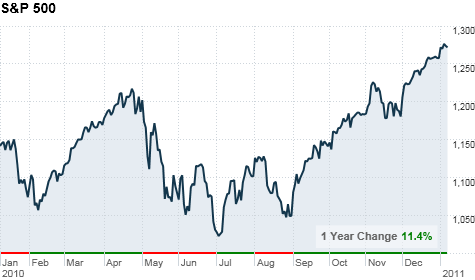
The S&P 500 rose more than 1% during the first trading week of 2011. Click the
chart for more stock market data.
Dow components Alcoa (AA, Fortune 500), Intel (INTC, Fortune 500) and JPMorgan Chase (JPM, Fortune 500) all report quarterly financial results next week. Apollo Group (APOL) and homebuilder Lennar (LEN), which are both among the S&P 500 companies, will also open their books. Continue ►
The S&P 500 rose more than 1% during the first trading week of 2011. Click the
chart for more stock market data.
Dow components Alcoa (AA, Fortune 500), Intel (INTC, Fortune 500) and JPMorgan Chase (JPM, Fortune 500) all report quarterly financial results next week. Apollo Group (APOL) and homebuilder Lennar (LEN), which are both among the S&P 500 companies, will also open their books. Continue ►
Wednesday, January 5, 2011
Best Mobile Personal Finance Tool: Mint
Earlier last week we asked you to share your favorite mobile personal finance tool. We rounded up the nominations and put the top five before you for a vote. Now we're back with your favorite.
Leading the pack by a brutal landslide; Mint's mobile finance application took home 76% of the vote. Following behind Mint, Pageonce pulled in 14%. Rounding out the bottom of the Hive were Pocket Money (3%), EasyMoney (2%), and ProOnGo (1%).
Click on the chart below to see the results in graph form.
Best Mobile Personal Finance Tool: Mint
Have an idea for the next Hive Five? Shoot us an email at tips@lifehacker.com with "Hive Five" in the subject line and we'll do our best to get your idea the attention it deserves. Continue ►


Leading the pack by a brutal landslide; Mint's mobile finance application took home 76% of the vote. Following behind Mint, Pageonce pulled in 14%. Rounding out the bottom of the Hive were Pocket Money (3%), EasyMoney (2%), and ProOnGo (1%).
Click on the chart below to see the results in graph form.

Best Mobile Personal Finance Tool: Mint
Have an idea for the next Hive Five? Shoot us an email at tips@lifehacker.com with "Hive Five" in the subject line and we'll do our best to get your idea the attention it deserves. Continue ►
Wall Street rises on jump in private jobs number
NEW YORK (Reuters) - Stocks advanced on Wednesday as a much stronger-than-expected rise in private sector employment boosted optimism about the outlook for the economy and stocks.
The ADP Employer Services survey showed a rise in private payrolls in December of 297,000, nearly triple the number forecast by economists.
The report came two days before the government's employment report, and some analysts viewed the data as encouraging for that report and further stock gains.
 "The jobs data was really strong and that's consistent with other data we've been seeing. The economy is clearly accelerating," said Edward Hemmelgarn, president of Shaker Investments in Cleveland.
"It's difficult to make the case for the market to go down in the first six months of the year," said Hemmelgarn, who expects industrial shares, typically influenced by economic cycles, to do well this year.
The Dow Jones industrial average (DJI:^DJI - News) gained 37.13 points, or 0.32 percent, to 11,728.31. The Standard & Poor's 500 Index (^SPX - News) rose 5.20 points, or 0.41 percent, to 1,275.40. The Nasdaq Composite Index (Nasdaq:^IXIC - News) advanced 13.36 points, or 0.50 percent, to 2,694.61.
Leading the Dow was American Express Co (NYSE:AXP - News), up 3.1 percent at $45.11. Continue ►
The ADP Employer Services survey showed a rise in private payrolls in December of 297,000, nearly triple the number forecast by economists.
The report came two days before the government's employment report, and some analysts viewed the data as encouraging for that report and further stock gains.
Traders work on the floor of the New York Stock
Exchange early in the trading session in New
York, January 3, 2011. REUTERS/Mike Segar
"It's difficult to make the case for the market to go down in the first six months of the year," said Hemmelgarn, who expects industrial shares, typically influenced by economic cycles, to do well this year.
The Dow Jones industrial average (DJI:^DJI - News) gained 37.13 points, or 0.32 percent, to 11,728.31. The Standard & Poor's 500 Index (^SPX - News) rose 5.20 points, or 0.41 percent, to 1,275.40. The Nasdaq Composite Index (Nasdaq:^IXIC - News) advanced 13.36 points, or 0.50 percent, to 2,694.61.
Leading the Dow was American Express Co (NYSE:AXP - News), up 3.1 percent at $45.11. Continue ►
Friday, December 31, 2010
Time Warner Cable tries end-run to broadcast bowl games in dispute with Sinclair over TV fees
Time Warner Cable, stuck in a dispute over fees with Sinclair Broadcast Group, says it will continue to provide network programming to viewers even if Sinclair pulls its stations off the cable system.
Time Warner's end run around Sinclair late Thursday is the latest twist in a long-running struggle between TV broadcasters and the cable and satellite operators that carry their signals into customers' homes.
As of midday Friday, Sinclair still didn't have a deal to carry its channels on Time Warner Cable Inc. and Bright House Networks. Previous contracts were set to expire at midnight.
The dispute had threatened to prevent cable customers in Sinclair markets around the country from seeing Saturday's Outback Bowl between Penn State and Florida. Time Warner has about 4 million customers who get local broadcast stations owned by Sinclair. Continue ►
Time Warner's end run around Sinclair late Thursday is the latest twist in a long-running struggle between TV broadcasters and the cable and satellite operators that carry their signals into customers' homes.
As of midday Friday, Sinclair still didn't have a deal to carry its channels on Time Warner Cable Inc. and Bright House Networks. Previous contracts were set to expire at midnight.
The dispute had threatened to prevent cable customers in Sinclair markets around the country from seeing Saturday's Outback Bowl between Penn State and Florida. Time Warner has about 4 million customers who get local broadcast stations owned by Sinclair. Continue ►
Tuesday, December 28, 2010
Dow, S&P close higher as energy rallies
NEW YORK (Reuters) - The Dow and S&P 500 rose in light trading on Tuesday, extending December's rally, as cold weather in the Northeast lifted oil prices and energy shares.
 The Dow Jones industrial average (DJI:^DJI - News) was up 20.51 points, or 0.18 percent, at 11,575.54, according to the latest available figures. The Standard & Poor's 500 Index (^SPX - News) was up 0.99 point, or 0.08 percent, at 1,258.53. The Nasdaq Composite Index (Nasdaq:^IXIC - News) was down 4.39 points, or 0.16 percent, at 2,662.88.
(Reporting by Angela Moon, Editing by Kenneth Barry) Continue ►
Traders work on the floor of the New York Stock Exchange,
December 15, 2010. REUTERS/Brendan McDermid
(Reporting by Angela Moon, Editing by Kenneth Barry) Continue ►
Saturday, December 18, 2010
Bullish on Tech and 2011
'Tis the season for investors to start looking ahead to 2011 and beyond. For that purpose, Barron's called on Stephen F. Auth, chief investment officer, equity, at Federated Investors, a large money manager headquartered in Pittsburgh. A seasoned investor who has been with Federated for a decade, Auth turned bullish on stocks in the spring of 2009. Since then, with the nearly $30 billion of equity assets he oversees at Federated, he has had his ups and downs with that call.
Continue ►
Friday, December 17, 2010
Will the Dow hit a record high in 2011?
NEW YORK (AP) -- Could the Dow set a record high next year?
That question would have seemed crazy early last year when fear and panic enveloped the stock market and the Dow Jones industrial average plunged to 6,547 on March 9. Many investors thought it would take a decade or longer to get back to the record of 14,165, set on Oct. 9, 2007.
Now we could be on the verge. The Dow has soared 76 percent the past 21 months, and it would have to climb just 23 percent from Thursday's close of 11,499 to set a record.
That's a big jump, but the Dow has risen 23 percent or more six times since 1985, or roughly 1 in 4 years. Many analysts don't expect quite that strong a run in 2011, but they agree conditions are in place for the rally to continue.
"There are some really compelling reasons out there that say the Dow could approach its highs," says Randy Bateman, chief investment officer for Huntington Asset Advisors. "You've got a fairly rosy scenario, where there isn't a whole lot of competition for stocks." Continue ►
That question would have seemed crazy early last year when fear and panic enveloped the stock market and the Dow Jones industrial average plunged to 6,547 on March 9. Many investors thought it would take a decade or longer to get back to the record of 14,165, set on Oct. 9, 2007.
Now we could be on the verge. The Dow has soared 76 percent the past 21 months, and it would have to climb just 23 percent from Thursday's close of 11,499 to set a record.
That's a big jump, but the Dow has risen 23 percent or more six times since 1985, or roughly 1 in 4 years. Many analysts don't expect quite that strong a run in 2011, but they agree conditions are in place for the rally to continue.
"There are some really compelling reasons out there that say the Dow could approach its highs," says Randy Bateman, chief investment officer for Huntington Asset Advisors. "You've got a fairly rosy scenario, where there isn't a whole lot of competition for stocks." Continue ►
Subscribe to:
Posts (Atom)


 Posts
Posts


 RSS Feed
 Twitter
 Facebook